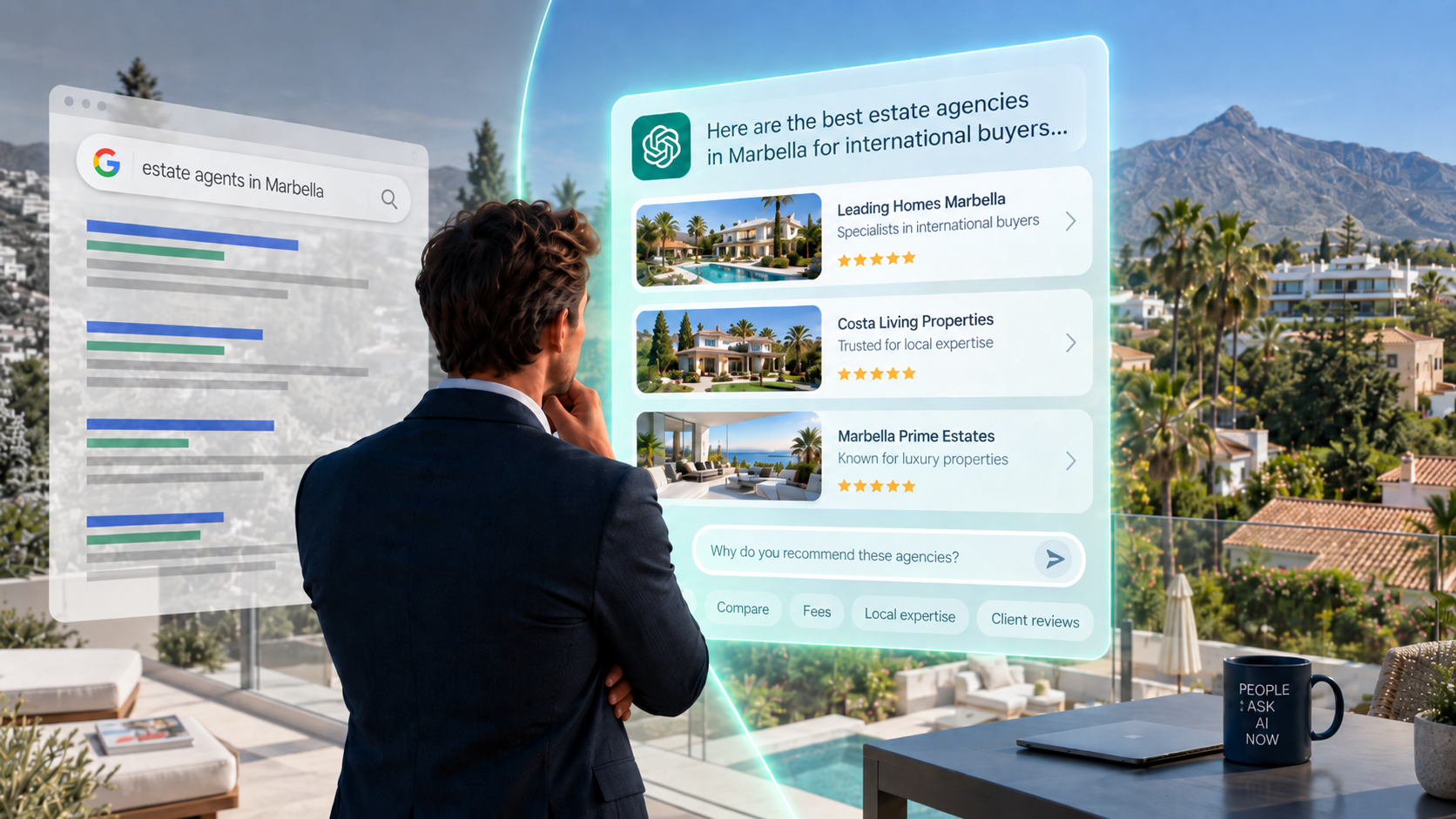
SEO helps you get found. GEO focuses on how you are understood and represented in AI-generated answers.
For more than 20 years, businesses have competed for visibility through search engines.
A customer searches Google. Google presents results. SEO helps businesses improve their ability to appear prominently for relevant searches.
AI is adding another way for customers to discover and choose companies.
Today, somebody can ask ChatGPT, Gemini or another AI platform:
“Which estate agent should I use to sell my luxury property in Dubai?”
Instead of simply receiving a list of websites, they may receive a small number of companies, an explanation of their strengths and, in some cases, a direct recommendation.
That creates a new visibility challenge.
SEO and GEO overlap. The distinction is primarily in the outcome being optimised: visibility within search results, and how a business is included, described and recommended within AI-generated answers.
What is SEO?
SEO stands for Search Engine Optimisation.
Its purpose is to improve a website's visibility when people search for relevant information, products or services.
If someone searches:
“Estate agents in Marbella”
SEO helps an agency compete for a prominent position in those results.
That involves much more than simply adding keywords to a website.
Modern SEO considers technical accessibility, useful content, search intent, authority, external signals and the overall quality and relevance of the website.
Success is commonly measured through:
- Search rankings
- Organic traffic
- Search impressions
- Clicks
- Conversions
The objective is ultimately to increase the business's visibility when somebody searches for something relevant.
What is GEO?
GEO stands for Generative Engine Optimisation.
It focuses on how businesses and information are discovered, interpreted and represented by generative AI systems.
A customer might ask:
“Which estate agent should I use to sell a villa in Emirates Hills?”
An AI platform can interpret the question, compare relevant companies and explain its recommendations.
The customer may therefore begin forming an opinion about those companies before visiting any of their websites.
That introduces a different question for businesses:
What does AI understand about us, and when does it consider us relevant enough to include in an answer?
Search results and AI answers are different customer experiences
Traditional search usually gives customers a set of results to explore.
Generative AI can go further by bringing information together, comparing options and providing an answer.
This does not make SEO irrelevant.
Many of the things that create a strong search presence, including useful content, clear website architecture, authority and credible external references, can also support visibility within AI systems. For Google's own generative Search features specifically, Google says existing SEO best practices remain relevant.
But the commercial outcome can be different.
Businesses are competing to appear in search results and to be included in the answers and recommendations customers receive.
SEO vs GEO in simple terms
The table below compares the typical emphasis of each approach. Many of the underlying activities support both.
| SEO | GEO |
|---|---|
| Focuses on visibility within search engines | Focuses on visibility and representation within generative AI answers |
| Targets relevant searches and the intent behind them | Tests how a business appears across customer questions and follow-up conversations |
| Competes for visibility in search results | Competes for inclusion within generated answers, comparisons and recommendations |
| Commonly aims to generate website traffic and conversions | Can influence consideration before somebody visits the website |
| Measures rankings, impressions, traffic and conversions | Measures recommendation visibility, prompt coverage and visibility across AI platforms |
| Builds website relevance and authority through content, technical work and external signals | Uses many of those foundations while addressing how AI systems describe, cite and recommend the business |
The distinction is therefore not that SEO cares about relevance while GEO does not.
Both depend on relevance and authority. GEO asks an additional question: how does that information translate into the answers AI gives customers?
Why this matters for real estate companies
Imagine two estate agencies.
Both have attractive websites.
Both have experienced teams.
Both perform reasonably well in search.
The first also has a clear digital footprint demonstrating its locations, advisers, specialist markets, transaction experience, customer groups, market knowledge, reviews and services.
The second may possess very similar expertise, but much of the evidence is scattered across PDFs, CRM systems, portals, agent knowledge and disconnected web pages.
From inside the businesses, their capabilities may look similar.
From the information available to an AI system, they may look very different.
That gap between what a company genuinely knows and what its digital footprint demonstrates is becoming increasingly important.
Our research shows why one AI ranking is not enough
Schutle analysed 10,560 AI-generated responses to 116 commercially relevant real estate prompts across Dubai, London and Marbella.
The research found that there was no universal AI visibility leader.
Different companies led different customer needs, locations and prompt variations.
It also found meaningful differences between AI platforms, meaning a company could perform strongly within one model while having significantly weaker visibility elsewhere.
This is why Schutle measures AI visibility across a portfolio of commercially relevant questions rather than relying on a single generic prompt.
GEO is not a replacement for SEO
The strongest digital strategies are unlikely to choose between SEO and GEO.
They will consider both.
SEO remains essential for helping customers and search engines discover useful content and businesses.
GEO adds another objective:
making sure AI systems can clearly understand what a business does, where its expertise lies and what credible evidence supports that position.
The same content, reputation, authority and technical foundations can contribute to both.
But the measurement changes.
Instead of looking only at rankings and traffic, businesses can also begin asking:
Are we being recommended?
What are we being recommended for?
Which competitors appear instead?
What does AI associate with our brand?
Is that consistent across different AI platforms?
The Schutle view
We do not see GEO as a way of manipulating AI systems.
The objective is to make accurate, useful and credible information about a business easier for machines to discover and understand.
That means creating a clearer digital representation of the things that genuinely make the company valuable:
its people, expertise, markets, experience, evidence and reputation.
AI visibility is not one universal ranking.
The goal is not to appear in every answer.
It is to become a credible and consistent answer to the customer questions most closely connected to your commercial priorities.
Customer discovery is expanding from search results to AI-generated answers.
SEO made it essential to compete for visibility in search.
GEO adds the need to understand how your business is represented when AI provides the answer.
The businesses best positioned for the next stage of digital discovery will be those that achieve both.
Does AI understand why customers should choose your agency?
Explore Schutle's research into how AI platforms recommend estate agents, or see how we help make your expertise and evidence easier for AI systems to discover and understand.
Read the research · Book a demo