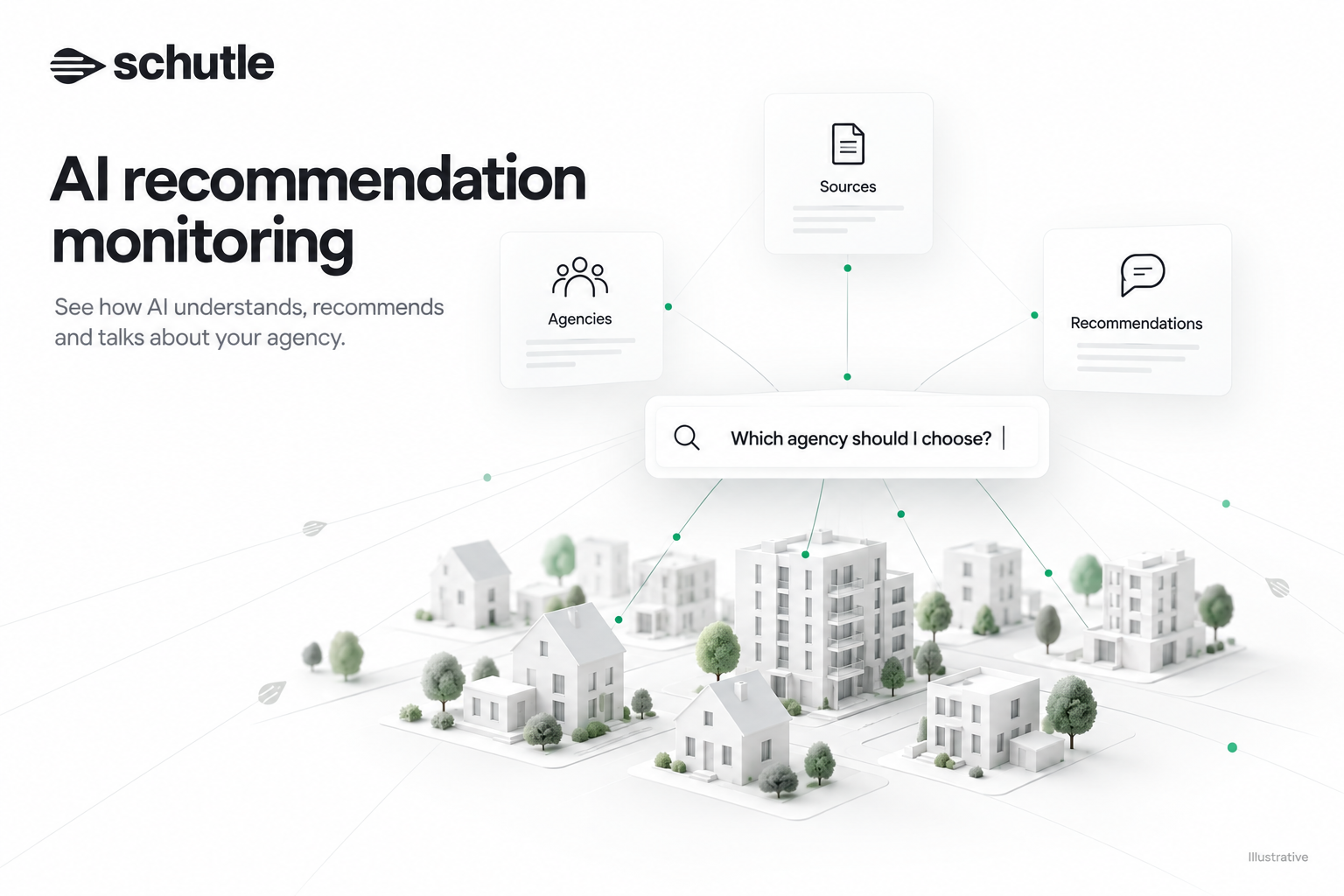
Schutle has developed a bespoke monitoring and analysis system specifically for real estate.
We test the questions your potential customers are asking across leading AI platforms and analyse which companies appear, how they are positioned, what evidence is visible alongside those recommendations and how the results change over time.
The result is a clearer picture of your AI recommendation landscape:
Where are you visible? Where are competitors being chosen instead? What does AI associate with your agency? And where should you focus next?
Built specifically for real estate
Real estate recommendations are highly dependent on context.
A homeowner asking:
“Which estate agent should I use to sell my family home in Walthamstow?”
is asking a very different question from:
“Which agency should help me sell my buy to let investments in Canary Wharf?”
Location matters.
So does property type, price point, customer nationality, language, service requirement and where the customer is in their decision.
That is why generic AI monitoring is not enough.
Schutle builds monitoring around the actual customer journeys and commercial priorities of the agency.
We examine how your company, locations, services, people, expertise and experience are represented within AI responses, alongside the publicly available information that may help AI systems understand those strengths.
The objective is not simply to find out whether your name appears.
It is to understand when your agency is considered relevant, what it is considered relevant for and where competitors are being recommended instead, why.
Monitor the questions you actually want to win
Your target prompts are the questions potential customers ask AI when researching property services or deciding which company to use.
They might include:
- Who should I use to sell my house in Islington?
- Which estate agency is best for landlords in East London?
- Who specialises in luxury villas in Dubai?
- Which Marbella agent is best for British buyers?
- Which property company should help me invest in off plan property in Dubai?
Schutle agrees the monitoring scope with you around the markets, services and customer groups that matter commercially.
We then test those questions repeatedly to build a picture of the recommendation environment around your business.
Find the gaps that actually matter
Knowing that you are absent from an answer is useful.
Understanding why that might matter and what to investigate next is much more valuable.
Schutle's analysis helps distinguish between several different situations.
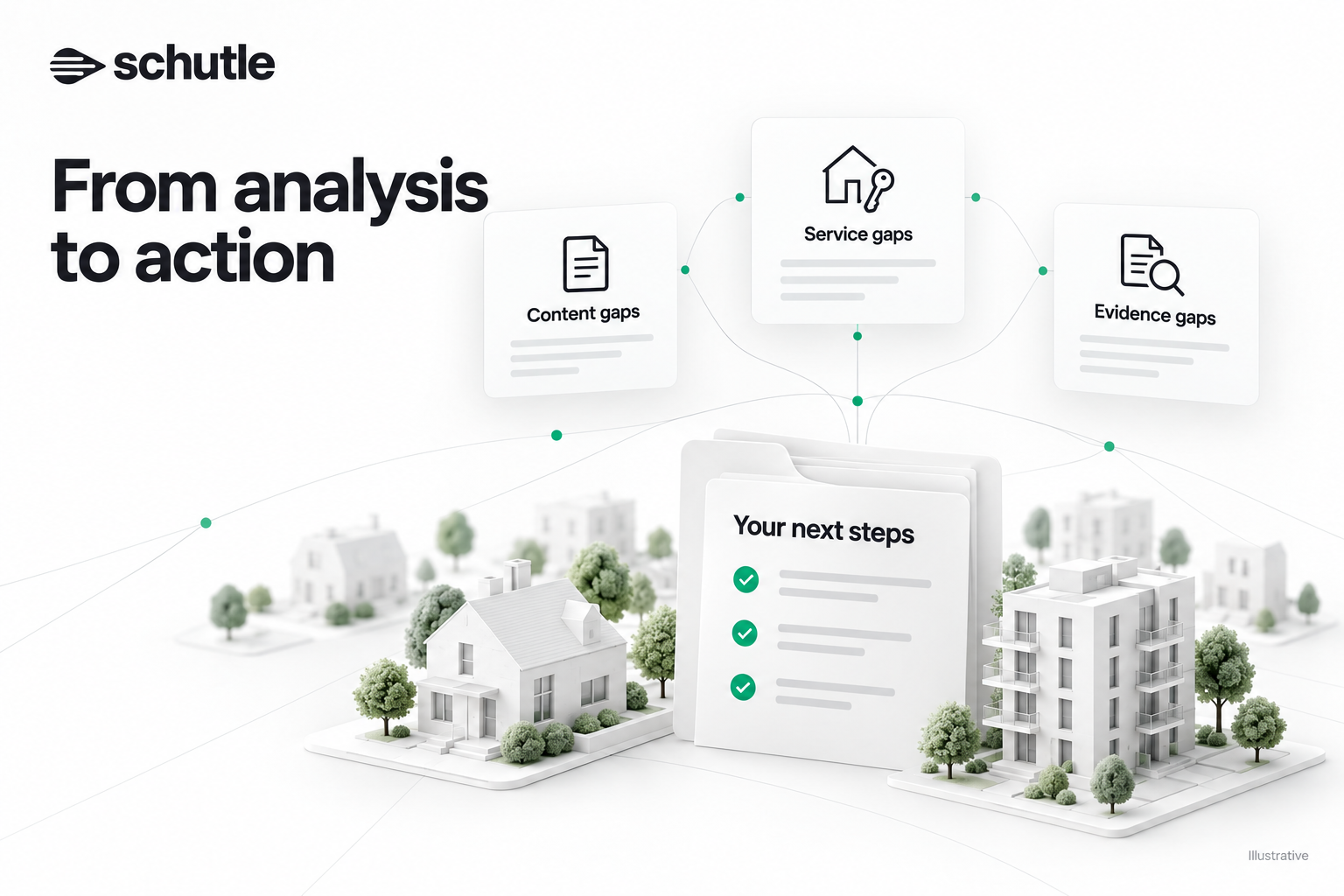
A content gap may exist when an important customer question is not being answered clearly or with sufficient depth.
An evidence gap exists when the agency genuinely has a capability, but there is insufficient accessible information demonstrating it.
A capability gap may exist when competitors are being recommended for a service or strength the business genuinely does not currently offer.
We may also identify competitor displacement, where another agency consistently occupies a customer-intent position you want to own, or model dependency, where apparent strength is concentrated within one AI platform.
These are very different problems.
They should not receive the same solution.
AI answers vary. That is why methodology matters.
AI recommendation monitoring is not the same as checking ChatGPT once and recording the answer.
Responses can vary between sessions, models and periods.
That is why meaningful monitoring requires:
consistent prompts, clearly defined classifications, appropriate sample sizes, repeat testing and transparency about changes to the monitoring scope.
Schutle distinguishes between a business being mentioned, cited and recommended.
We also distinguish AI recommendation visibility from crawler activity, website referrals, enquiries and conversions.
Each measures something different.
The objective is not to create false precision.
It is to build a more reliable picture of how AI systems are representing the businesses competing for your customers.